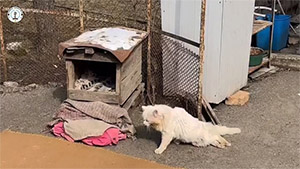
For an older stray cat, approaching a stranger can be a dangerous decision.
Years of life on the streets usually teach cats to be cautious. They learn where to hide, when to run, and how to keep enough distance from people to protect themselves. But when Sam encountered a gentle hand reaching toward him, he did something that seemed almost impossible for a cat who had spent so long surviving alone.
He walked closer.
Instead of disappearing into the shadows, Sam leaned toward the person offering him comfort. It was a small gesture, but it opened the door to a completely different life.

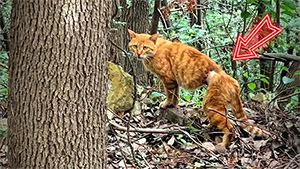
At the time, no one knew how many years Sam had spent outdoors in Bulgaria. His rescuer, Anastasia Ilich, estimated that he was somewhere between seven and twelve years old. Whatever his exact age, his appearance made one thing clear: life had been extraordinarily hard on him.
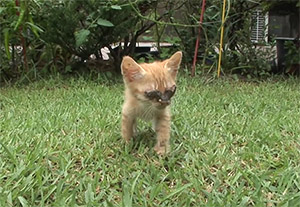
Sam was painfully thin, and his long-neglected coat had become tangled and heavily matted. But the most serious problem was hidden around his mouth. A large tumor had dramatically affected his lower jaw, making one of the most basic things an animal needs to do—eat—an exhausting and painful experience.
Yet Sam still tried.
He would approach food and struggle through meals despite the discomfort. For an experienced animal rescuer, that behavior was impossible to ignore. Cats are often remarkably good at concealing pain, and when eating becomes visibly difficult, it can indicate a serious underlying problem that requires veterinary attention.
Sam needed more than food and a warm bed. He needed answers.
Every Examination Seemed to Close Another Door
His rescue was followed by a series of veterinary appointments, examinations and diagnostic scans. The results were difficult, and several veterinarians were concerned about the risks involved in attempting surgery.

Because the tumor had significantly affected Sam’s jaw, removing it could involve complicated surgery and potentially require removal of part of the affected bone. There was also the uncertainty that comes with operating on an older, severely underweight animal whose body had already endured years of hardship.
For his rescuer, each difficult consultation brought another reason to be afraid of what might happen next.
But Sam seemed to have his own opinion.
Despite his condition, he remained affectionate. In the evenings, he would climb onto his rescuer’s chest and settle down, quietly purring as though he had finally found somewhere he felt safe.
Then, when morning came, he would try to eat again.
Those ordinary moments became the reason his rescuer continued searching for another possibility.
Eventually, that search led them to Dr. Voichev, a surgeon in Sofia.
Further examinations offered the piece of information everyone had been hoping for: there was no evidence that the tumor had spread.
That changed the conversation.

The goal was not to restore Sam to some imaginary version of perfect health. It was much simpler and much more important—to relieve his suffering and give him the ability to eat and live more comfortably.
After careful consideration, Sam underwent a complex mandibulectomy, a procedure involving removal of the diseased portion of his lower jaw.
For everyone who had grown attached to him, the hours surrounding the operation were filled with uncertainty.
Then came the news they had been waiting for.
Sam had survived.
His Recovery Happened One Small Victory at a Time
There was no dramatic overnight transformation.
Instead, Sam’s recovery unfolded through a collection of quiet moments that gradually became more meaningful.
He slept peacefully.
His appetite improved.

Meals became less of a struggle.
His body slowly regained strength, and the cat who had once seemed constantly exhausted began showing more curiosity about his surroundings.
For his caregivers, these changes were enormous.
A cat who has spent years in survival mode does not necessarily regain confidence instantly after being rescued. Safety has to be learned through repetition. A warm room, regular meals, gentle handling and predictable routines can gradually teach an animal that it no longer needs to remain on constant alert.
Sam seemed to be learning that lesson every day.
He explored his surroundings more confidently. He rested without the same visible discomfort. His personality began to emerge beneath the physical suffering that had dominated so much of his earlier life.
And perhaps most importantly, he could finally enjoy food without every meal becoming a battle.

Sam Finally Got the Life He Had Been Waiting For
Today, Sam’s world looks very different from the streets where he once searched for food.
He has a safe home, regular veterinary monitoring and someone who refused to stop looking for an answer when the first answers were discouraging. He can rest comfortably, explore his surroundings and spend his days without having to worry about where his next meal will come from.
His story is also a reminder that age should not automatically define an animal’s future.
Senior cats can still have years filled with comfort, affection and meaningful companionship. Their needs may change with age, particularly when chronic illness or previous neglect is involved, but appropriate veterinary care and attention to quality of life can make an enormous difference.
Sam’s journey was never about guaranteeing a perfect outcome.

It was about giving him a chance.
A chance to eat without suffering. A chance to sleep somewhere warm. A chance to trust a human hand. A chance to discover that life could contain more than hunger, fear and pain.
And perhaps the most beautiful part of his story happened before anyone knew whether he could be saved.
It happened when Sam saw a stranger reaching toward him—and chose not to run.
That small decision brought him the care he desperately needed and ultimately led him home.
After years of surviving, Sam finally has something he had been missing for far too long: a life in which he no longer has to fight simply to make it through another day.