
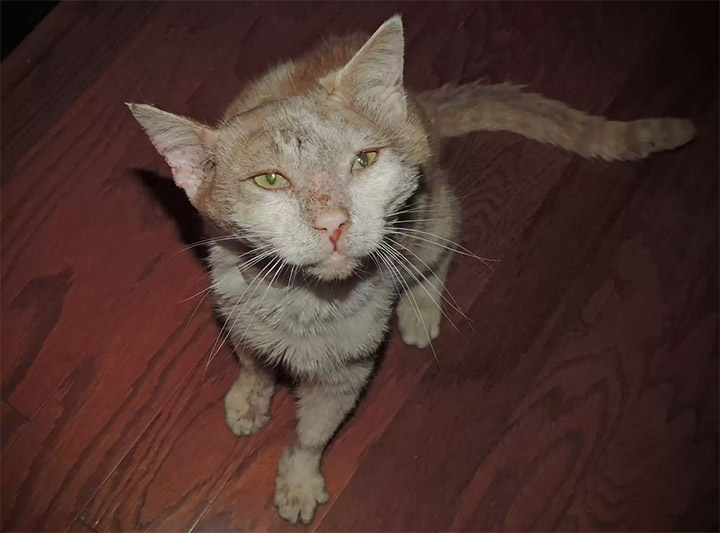
When the thin, battered animal slowly appeared in Pamela Latham’s yard, nobody in the family immediately understood what they were looking at. The creature moving toward them looked exhausted and badly injured, with so little fur remaining and so much swelling around his face that it was difficult to recognize him as a cat.
But beneath the wounds, there was still a living animal asking for help.
Latham and her family were outside their home when they noticed the Stray Cat approaching. He moved slowly, as though every step required more energy than he could afford to spend. His appearance suggested that he might have survived a violent encounter with another animal or perhaps been struck by a vehicle, although there was no way to know exactly what had happened to him on the streets.
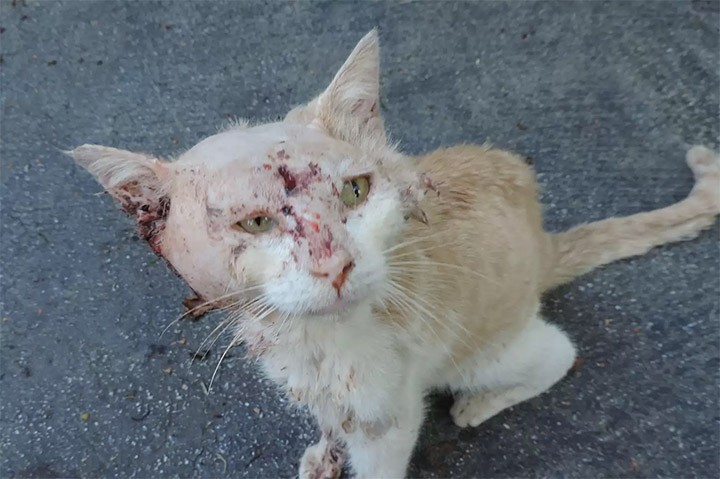
What Latham did know was that leaving him outside was not an option.
She carefully brought him inside and tried to make him as comfortable as possible. A soft bed was prepared so he could rest, and rather than expecting him to recover on his own, she arranged for him to see a veterinarian the following day.
The examination revealed just how serious his condition really was.
The veterinarian was shocked by the extent of his injuries. The cat had numerous puncture wounds across his body, with particularly severe injuries around his face that had become infected. Large areas of fur were missing, and his body was covered with fleas and ticks. He was suffering from a ruptured eardrum and a fever, while swelling around his eyes had become so severe that they were nearly closed.
He was also extremely thin.
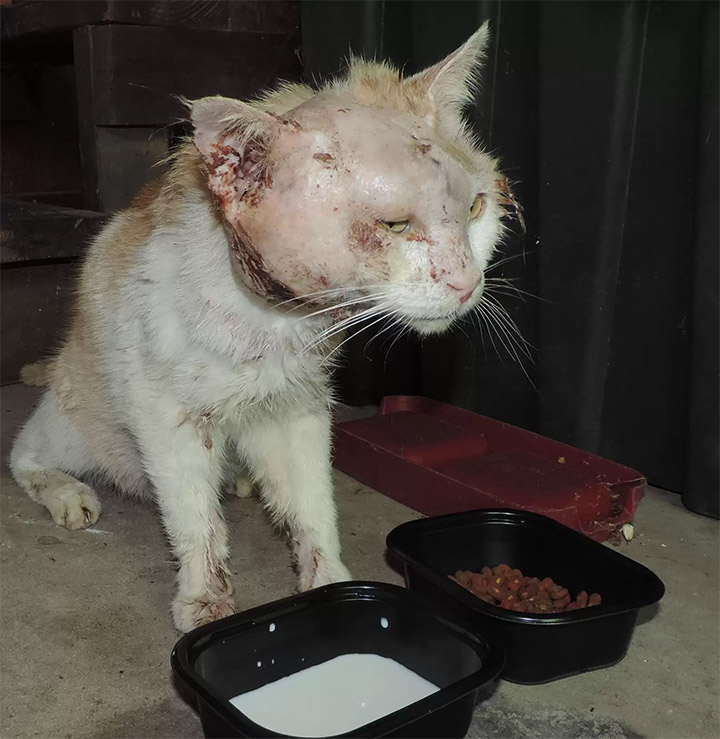
For an animal living outdoors, severe weight loss can be far more dangerous than simply looking underfed. Prolonged malnutrition weakens muscles, compromises immune function, and leaves the body with fewer resources to fight infection and repair damaged tissue. Combined with untreated wounds and parasites, his condition could have become life-threatening.
Yet the veterinarian believed there was still hope.
There was no way to erase what the cat had endured, but with appropriate treatment, nutrition, rest, and a safe environment, his body had an opportunity to begin repairing itself.
The family decided to give him that opportunity.
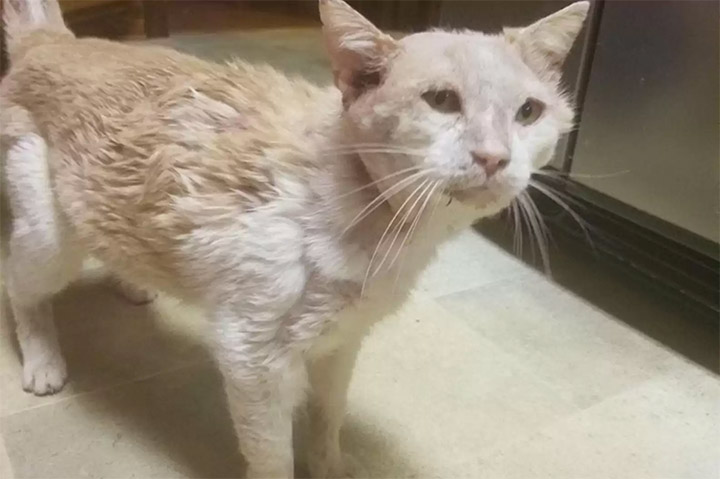
Because Latham had only just found him, the cat did not have a name. When the veterinarian asked what he should be called, Latham explained that they had not yet had enough time to choose one.
The veterinarian suggested Battle Cat.
The name seemed almost impossible to resist.
It captured something important about the battered animal lying on the examination table. He had arrived carrying the physical evidence of a difficult life, yet he was still there, still eating, still breathing, and still responding to the people trying to help him.
Once Battle Cat returned home with Latham, his recovery began in earnest.
He was encouraged to eat and drink whenever he was willing, allowing his body to gradually replenish the energy it had been missing for so long. He was given a quiet place to rest while his wounds were treated and his infections were brought under control.
Then, surprisingly quickly, signs of improvement began to appear.
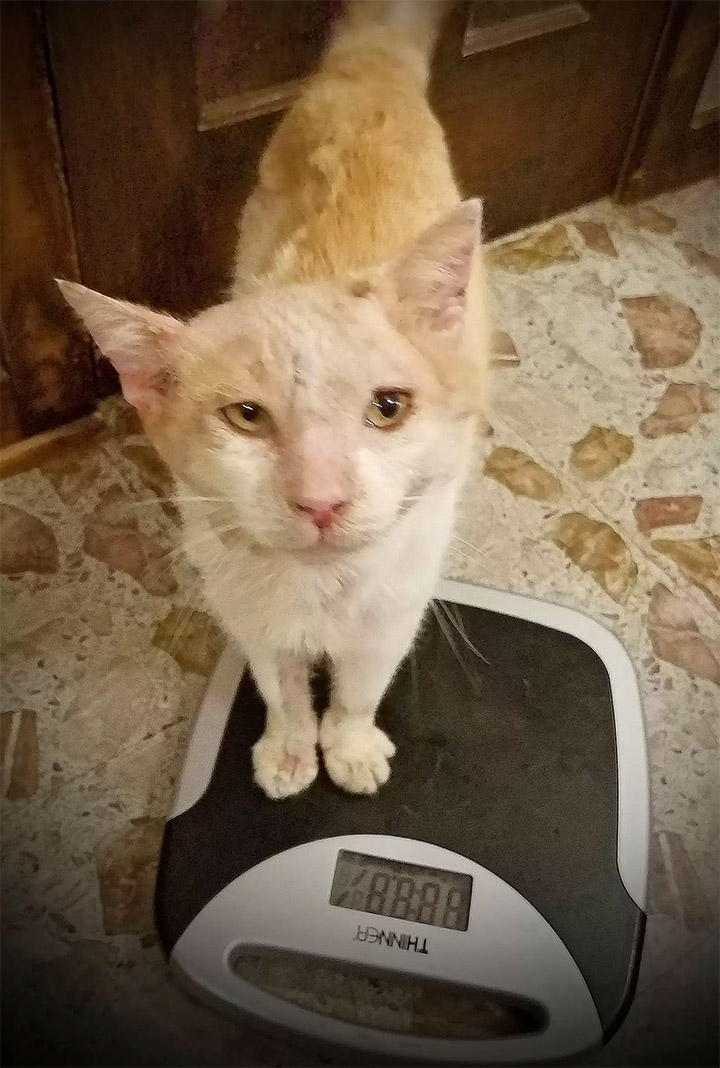
His appetite increased. His energy returned. His face slowly began to look less swollen, and the frightened, exhausted animal who had wandered into the yard started revealing a completely different personality.
He wanted affection.
He enjoyed being petted and became increasingly comfortable around the people caring for him. Instead of behaving like a frightened animal expecting the worst, he began showing himself to be remarkably gentle and easygoing.
Just ten days after he was discovered, the transformation was astonishing.
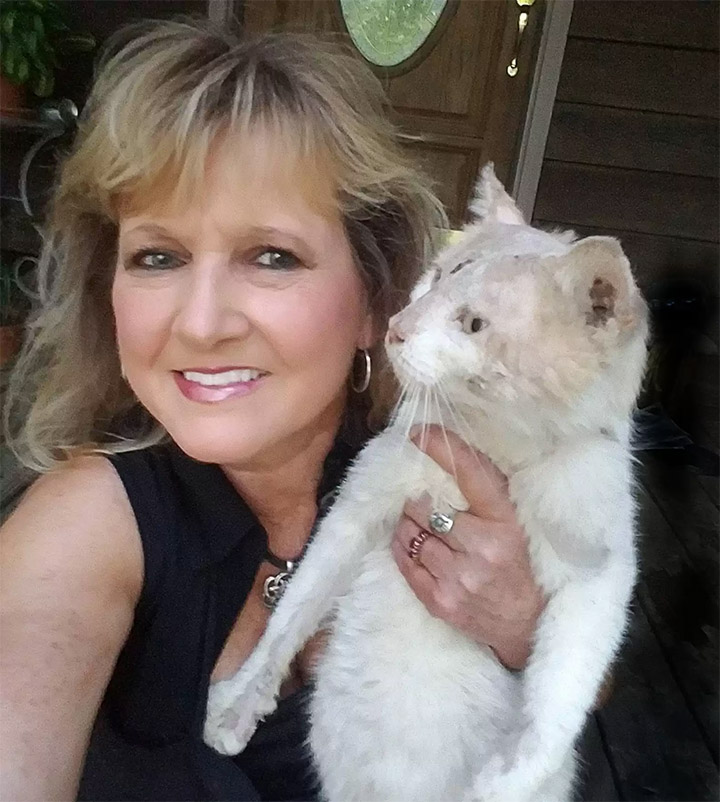
He still had significant hair loss, which the veterinarian attributed to the severity of his previous infection, and his coat would need time to grow back. Nevertheless, the difference was unmistakable. The skeletal, injured cat who had arrived looking almost unrecognizable was becoming a healthy companion again.
Latham eventually gave him another official name: Lazarus.
The name carried its own meaning, but Battle Cat remained the nickname that everyone continued to use because it represented the journey he had survived.
What makes his story especially moving is not simply how different he looked after treatment. It is the personality that emerged once his physical pain began to ease.
Despite everything he had experienced, Lazarus was affectionate, calm, and remarkably trusting. He enjoyed spending time with his new family and even discovered that riding in the car could be part of his new life.
For an animal who had spent so much time surviving outdoors, these ordinary experiences were anything but ordinary.
From an animal welfare perspective, Battle Cat’s recovery also demonstrates why appearance alone should never determine an animal’s fate. A severely injured stray may look beyond help, but appearance is only a snapshot of a moment. With veterinary treatment, proper nutrition, parasite control, pain management, and a stable environment, animals can sometimes recover in ways that seem remarkable.
When this Stray Cat first walked into Pamela Latham’s yard, he looked like an animal whose luck had finally run out.
Instead, someone stopped and looked closer.
Someone saw more than the wounds, the missing fur, and the swollen eyes. They saw a living creature worth saving.
Today, Lazarus is no longer defined by the injuries he carried onto that driveway. He is the affectionate cat who loves attention, enjoys companionship, and is finally discovering what it feels like to belong.
His scars may take time to disappear, and some may remain forever, but they no longer tell the whole story.
The rest of his story is about survival, kindness, and a second chance that arrived just when he needed it most.


