
When a shelter is supposed to be a place of safety, the animals inside should be able to rest without fear of hunger, injury, or attack. Sadly, not every animal facility provides that basic protection. Sometimes, the very creatures brought there in the hope of being helped are left in environments so chaotic and neglected that simply surviving becomes a daily struggle. For Mike, a blind tabby cat who had already lost both of his eyes, this was the frightening reality he faced before a group of rescuers arrived and changed the direction of his life.
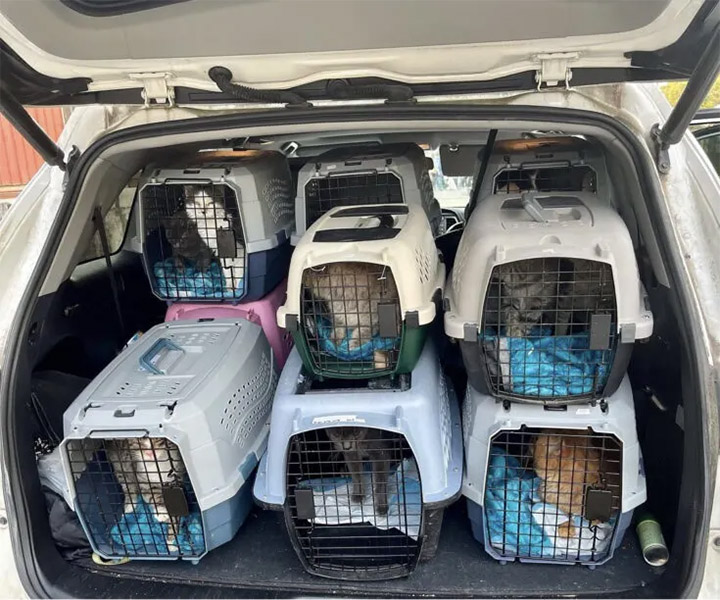
Mike’s rescue began with an urgent call received by Sarah Richardson of Community Cats of Central Arkansas. A shelter in eastern Arkansas was reportedly being closed amid serious concerns about animal neglect and possible abuse, leaving hundreds of cats and dogs in desperate need of somewhere safe to go. Several rescue organizations quickly came together to help relocate the animals, but the situation was overwhelming. There were far more cats than available foster spaces, and the rescuers had very little time to organize their response.
A Disturbing Call
When Sarah arrived, she was confronted with conditions that were difficult to forget. Hundreds of animals were reportedly roaming throughout the property, while others were confined in overcrowded kennels. The environment offered little protection from the dangers created by so many frightened animals living in close proximity, and the cats were left navigating a setting where finding something as basic as food or water could put them at risk.
Then Sarah noticed Mike.
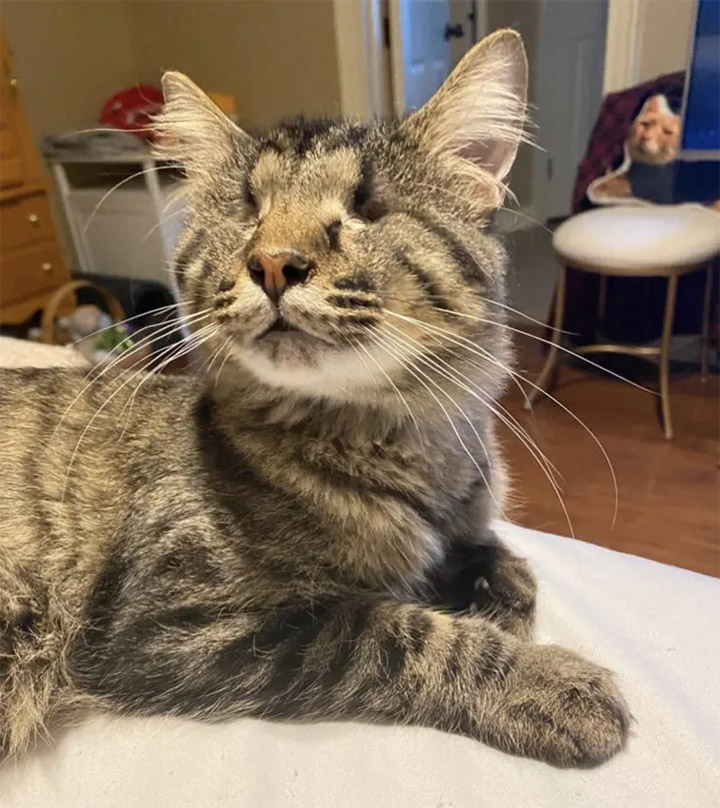
He was a blind tabby who had already lost both eyes, making him particularly vulnerable in an environment filled with unfamiliar animals and hazards. He had been wandering around the property when a loose dog reportedly attempted to attack him. Fortunately, someone intervened before the situation became fatal, but moving Mike into the shelter’s designated cat area did not solve the larger problem.
The room itself was in terrible condition.
There were holes in the walls and ceiling, and parts of the roof were damaged, leaving the cats exposed to an environment that offered little security. Animals hid wherever they could, searching for places where they might feel protected. Even finding food could become dangerous because cats sometimes had to leave their confined spaces and move through areas occupied by dogs.
A Shocking Discovery
For a sighted, healthy cat, such surroundings would already have been frightening.
For Mike, they were potentially catastrophic.
Without vision, he had to depend on his other senses to understand where he was and what was happening around him. A sudden movement from another animal, an unfamiliar sound, or an obstacle in his path could put him in immediate danger. His blindness did not make him helpless, but it meant that he needed an environment where his surroundings were predictable and where other animals could not threaten him.
Sarah quickly realized that Mike could not wait.
The rescue team planned to make multiple trips because there were more than one hundred cats who needed transportation, but Mike was one animal who could not be left behind while the larger operation continued.
“He couldn’t wait,” Sarah explained. “We brought him home immediately.”
That decision may have saved his life.
But getting Mike out of the shelter was only the beginning.
Once he arrived in a safe environment, veterinary evaluation revealed that his body had been struggling with several serious problems. He was dealing with an upper respiratory infection, severe diarrhea, dehydration, and difficulty breathing. After everything he had endured, his body was clearly exhausted.
Yet something about Mike immediately surprised his rescuers.
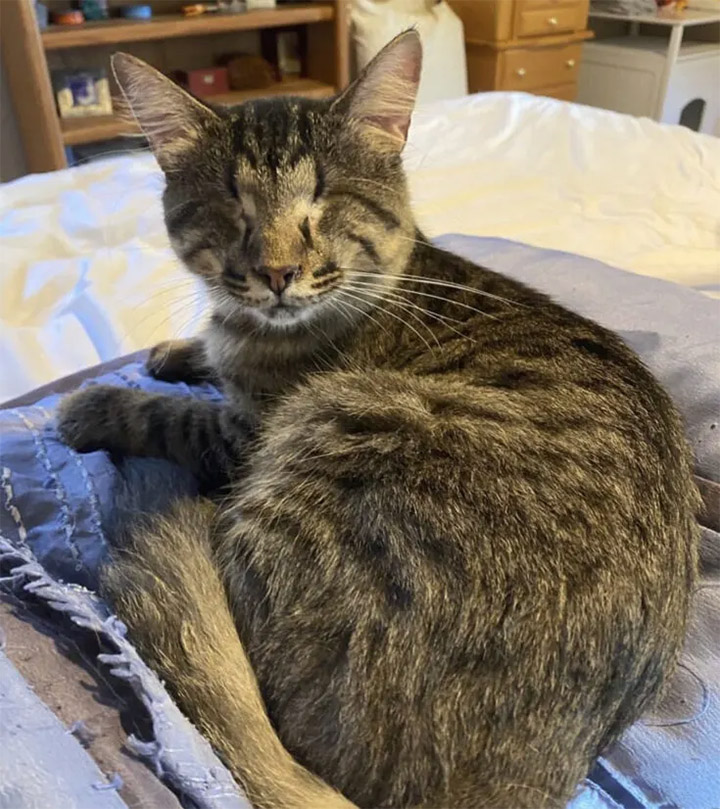
He was incredibly affectionate.
Despite being blind, sick, and frightened, he continued seeking human contact. Rather than hiding from his caregivers, he wanted to be held. He responded to gentle voices and seemed to relax whenever someone gave him affection.
Rushing to The Rescue
Sarah described him as one of the sweetest cats imaginable, noting that all he seemed to want was to be loved and close to people.
For an animal that had spent so much time in an unstable environment, this willingness to trust was remarkable.
His recovery required patience and careful veterinary management. Mike received fluids to help correct dehydration, along with antibiotics and treatment for parasites. His caregivers monitored his breathing, appetite, digestion, and overall energy closely, knowing that a cat in his condition could deteriorate quickly if complications developed.
Slowly, however, Mike began responding.
His energy returned little by little.
He started becoming more interested in his surroundings, and the quiet personality hidden beneath his illness began to emerge.
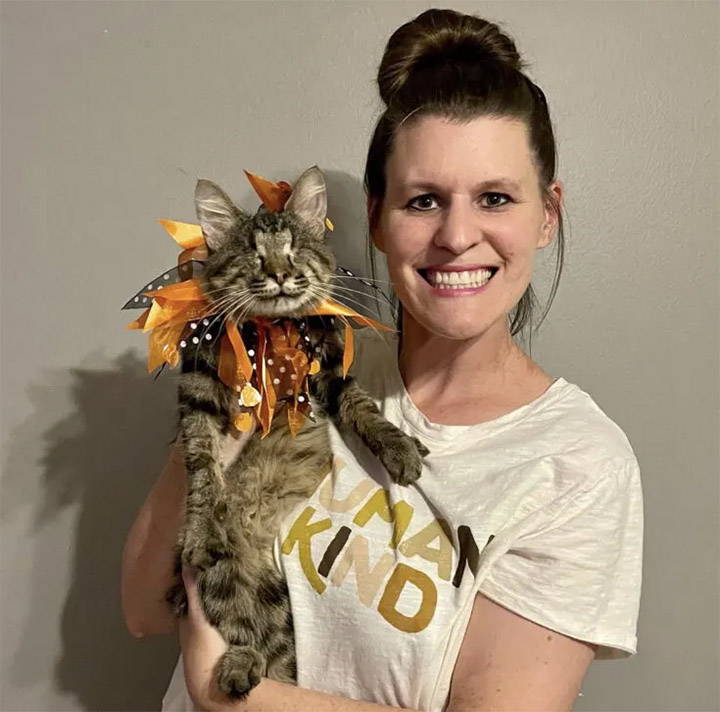
One of the most fascinating aspects of caring for a blind cat is witnessing how effectively the animal learns to use senses that sighted animals may rely on less heavily. Mike began navigating his foster environment through sound, smell, touch, and memory. He learned where important objects were located and became increasingly comfortable moving around his surroundings.
The Road to Recovery
He was cautious, and that caution made perfect sense.
In his previous environment, making a mistake could have serious consequences. A wrong turn might put him in the path of a dog. An unfamiliar noise could signal danger. For Mike, carefully learning his surroundings was not simply a personality trait; it was part of how he protected himself.
But in his new environment, he gradually discovered that he no longer needed to live that way.
There were no loose dogs waiting to attack him.
There was food and clean water.
There were soft places to rest.
And there were people who wanted him to feel safe.
As Mike’s condition improved, Sarah began sharing updates about his progress. Each small victory mattered because it showed that the cat who had once been fighting simply to survive was finally being given an opportunity to enjoy life.
Two Peas in a Pod
Then, an unexpected message arrived.
Someone had seen Mike’s story and wanted to help.
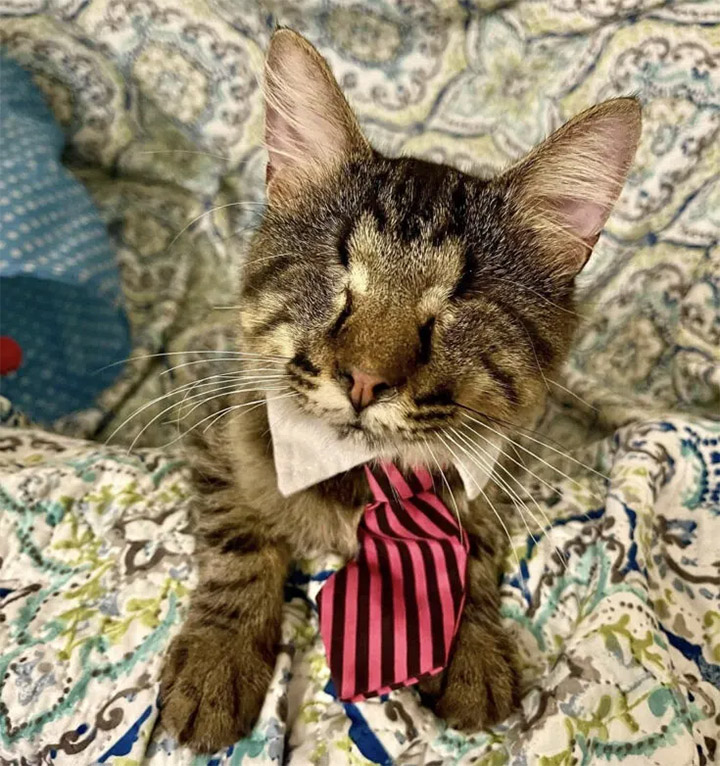
The person already had experience caring for a blind cat who had also lost both eyes. They understood that blindness did not prevent a cat from living a happy, comfortable life and offered to foster Mike with the possibility of adopting him permanently if everything went well.
It was an extraordinary opportunity.
After approximately a month of dedicated care, Mike was healthy enough to move into his new foster home.
And almost immediately, something became clear.
Mike had found his place.
He settled in as though he had always belonged there.
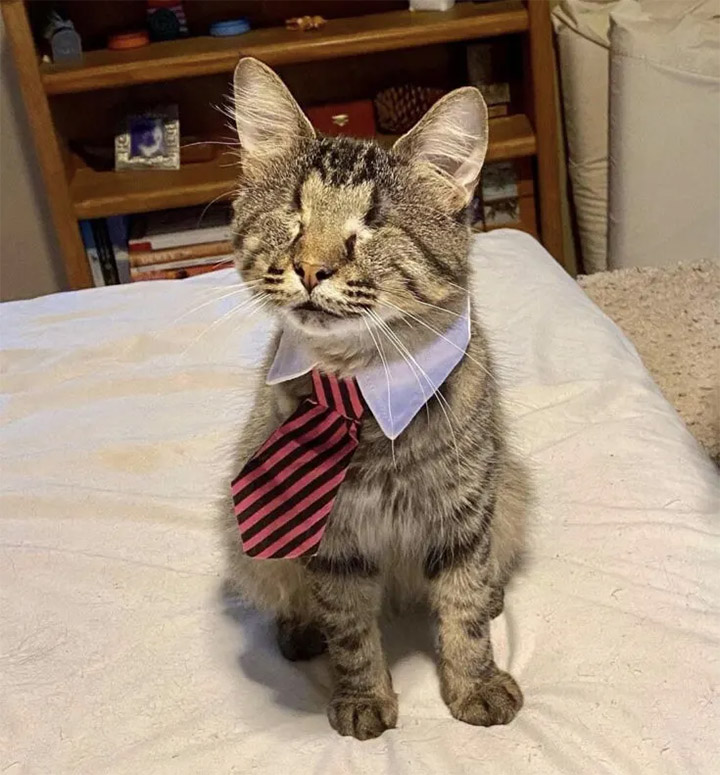
The foster family soon decided that they could not imagine giving him up, and Mike officially became part of the household. His new home was completely different from the environment he had known before. Instead of danger and uncertainty, he had warmth, routine, and people who understood how to care for him.
Happily Ever After…For Now
He also gained a very special companion.
Her name was Molly.
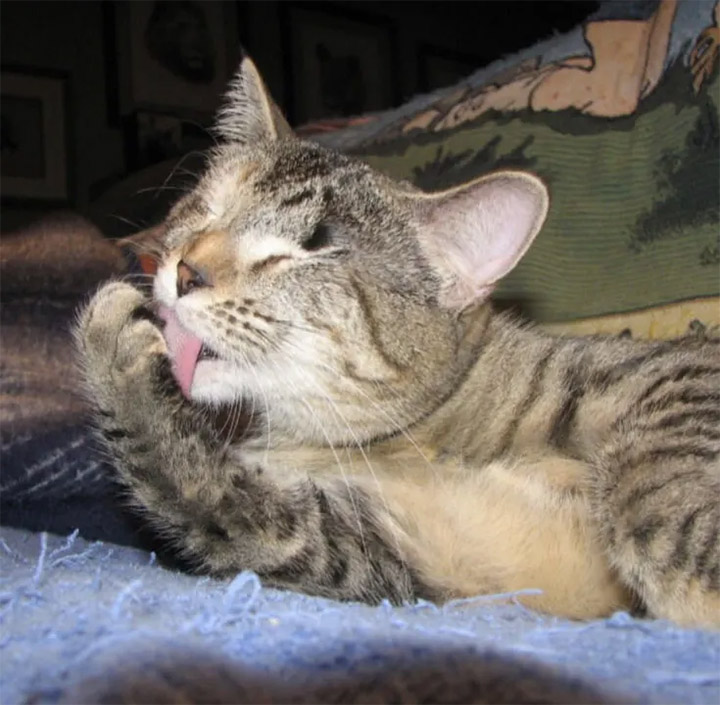
Molly was also blind and missing both eyes, making her perhaps the perfect feline sister for Mike. She understood the world in much the same way he did, relying on sound, scent, touch, and memory rather than vision. Instead of treating Mike as different, she simply welcomed him into her world.
The two cats quickly became companions.
There was something especially touching about seeing them together. Neither needed the other to explain what it meant to navigate life without sight. They simply shared the same home, the same routines, and the same understanding of how to move confidently through a world that looked very different from the one most cats experience.
Molly appeared to take on the role of an older sister, helping Mike settle into his new surroundings and giving him companionship whenever he needed it.
For Sarah, seeing Mike thrive in his new home was the outcome every rescuer hopes for.
“He really landed the perfect home,” she said.
Yet Mike’s story is not completely without challenges.
During his time at the shelter, he developed an unusual health condition that veterinarians were still working to understand. The filthy environment had reportedly exposed the animals to numerous sources of contamination, including vermin, and Mike’s unusual symptoms required further investigation.
Specialists were brought into the process as veterinarians worked to determine what underlying bacterial infection or other condition might be responsible. His future medical needs were still being assessed, which meant that his recovery remained an ongoing journey rather than a simple happily-ever-after ending.
But there was one enormous difference between the past and the present.
Mike was no longer facing those challenges alone.
Whatever diagnosis eventually came, he had people ready to care for him.
He had a safe home.
He had veterinary support.
He had Molly.
And he had something he had almost certainly been missing for much of his life: security.
Mike’s story is a powerful reminder that disability does not erase an animal’s ability to experience happiness. Losing both eyes changed how he interacted with the world, but it did not take away his capacity to love, explore, trust, play, or form deep relationships.
In fact, his blindness seemed to make his adaptability even more remarkable.
He learned to navigate.
He learned to trust.
He learned that human hands could bring comfort rather than danger.
Most importantly, he learned that he belonged somewhere.
The rescue also highlights the importance of speaking up when animals are living in unsafe conditions. Cats cannot report neglect, explain that they are hungry, or tell someone that they are being attacked. They depend upon people to notice when something is wrong and to intervene when necessary.
Mike was fortunate that rescuers arrived when they did.
One more day in that environment might have brought another attack, another infection, or another medical crisis.
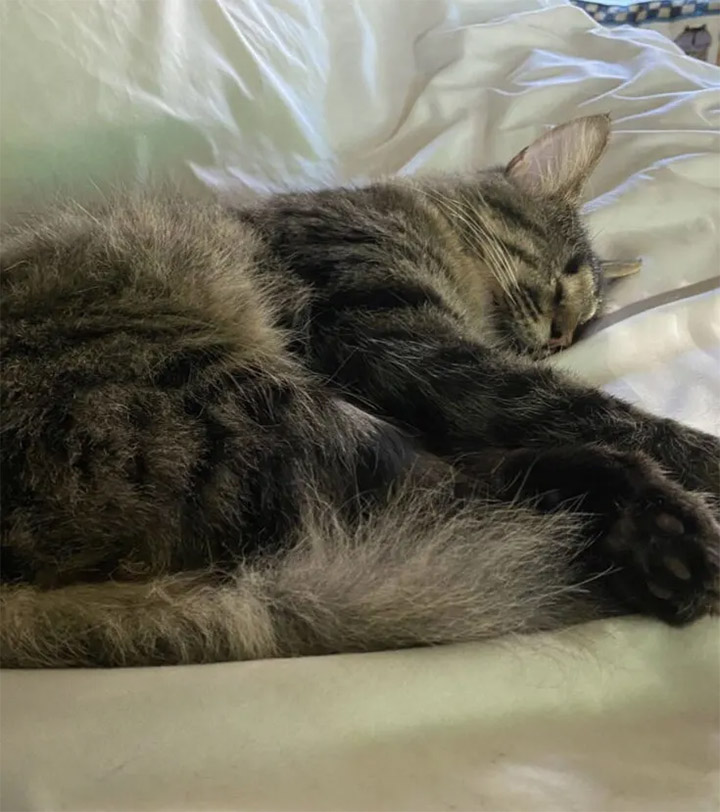
Instead, someone looked at a blind cat surrounded by danger and decided that his life was worth saving.
Today, Mike’s world is no longer defined by what he cannot see.
It is defined by what he can feel.
The warmth of a safe bed.
The sound of familiar voices.
The scent of his favorite people.
The reassuring presence of Molly nearby.
And the gentle touch of someone who has chosen to protect him.
Mike entered the rescue operation as a vulnerable cat who could barely survive in a dangerous shelter.
He emerged as something much more meaningful: a beloved companion with a future.
His story does not prove that every rescue ends perfectly, because real recovery is rarely that simple. Some animals carry lasting medical problems, and some require lifelong care. But Mike’s journey demonstrates that a difficult beginning does not have to determine the rest of an animal’s life.
He once had almost nowhere safe to turn.
Now, he has a home.
He once had to navigate danger without sight.
Now, he can explore without fear.
And he once had no idea whether anyone would come for him.
Now, he never has to wonder again.


