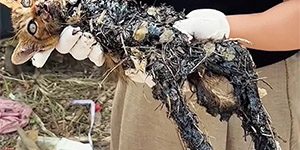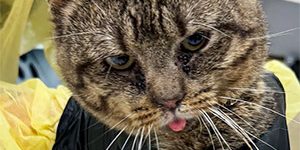
The tiny kitten was alone beside a busy road, just a short distance from passing vehicles, with no mother or family nearby to protect him. According to the account shared with his rescue, he had been abandoned despite being unable to properly use his two hind legs. For such a young and vulnerable animal, being left outdoors under those circumstances meant that even the simplest parts of survival—finding food, reaching water, hiding from danger, or escaping traffic—could become overwhelming challenges.
Then someone noticed him.
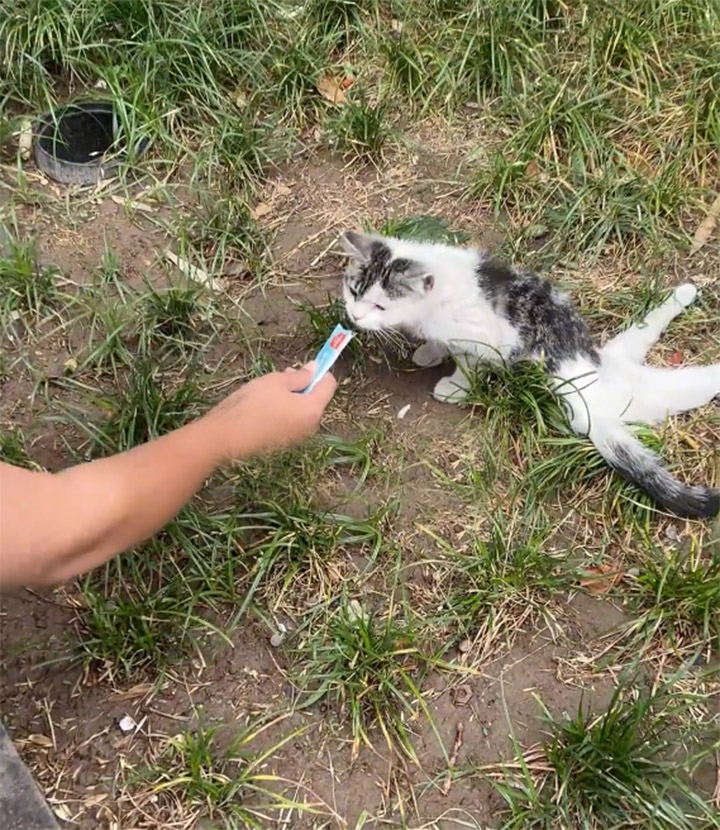
Perhaps the kitten had heard a familiar human voice or simply recognized that someone had stopped rather than continued driving past. Whatever was going through his mind, his reaction was heartbreaking. Unable to walk normally, he began pulling himself forward with his front legs, dragging the rest of his small body across the grass as he tried to reach the person who had finally come close enough to see him.
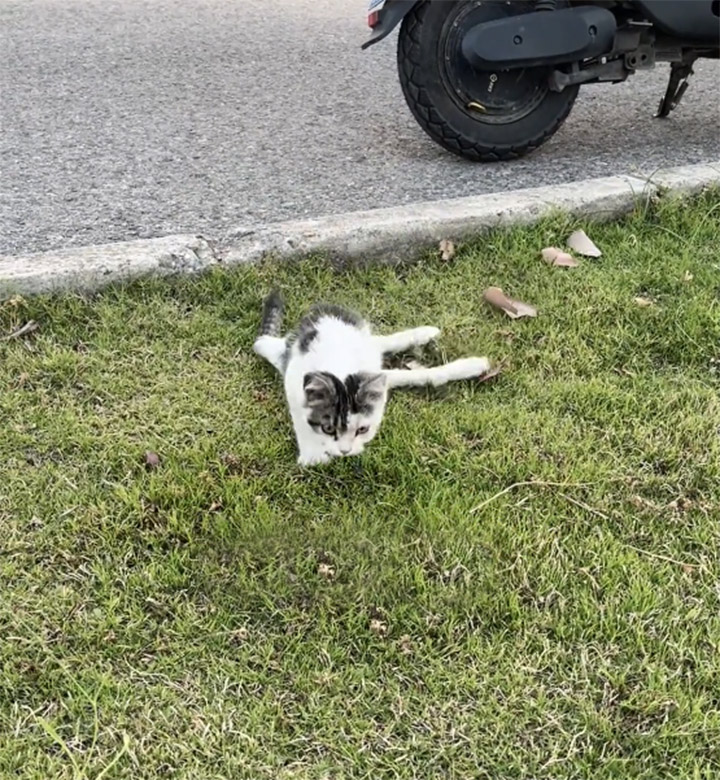
Every movement appeared difficult, yet he kept going.
There was something deeply moving about watching such a small animal continue forward despite having so little physical strength to rely on. His hind legs could not carry him, but his front legs still worked, and he used whatever ability remained to close the distance between himself and the stranger.
We cannot know exactly what the kitten was thinking in that moment. He may have associated people with food, he may have been frightened and looking for protection, or he may simply have sensed that this particular person was willing to help. Cats do not express their needs in the same way humans do, but their behavior can sometimes communicate a great deal. In this case, the kitten’s persistent attempt to move toward someone was enough to make the moment impossible to ignore.
His inability to use his hind legs also raised important medical questions. A photograph or short video alone cannot establish whether a kitten is permanently paralyzed. Hind-limb weakness or paralysis can have many causes, including trauma, spinal or nerve injuries, congenital abnormalities, infections, or other neurological conditions. Only a proper veterinary examination and appropriate diagnostic testing could determine what was actually happening to his body.
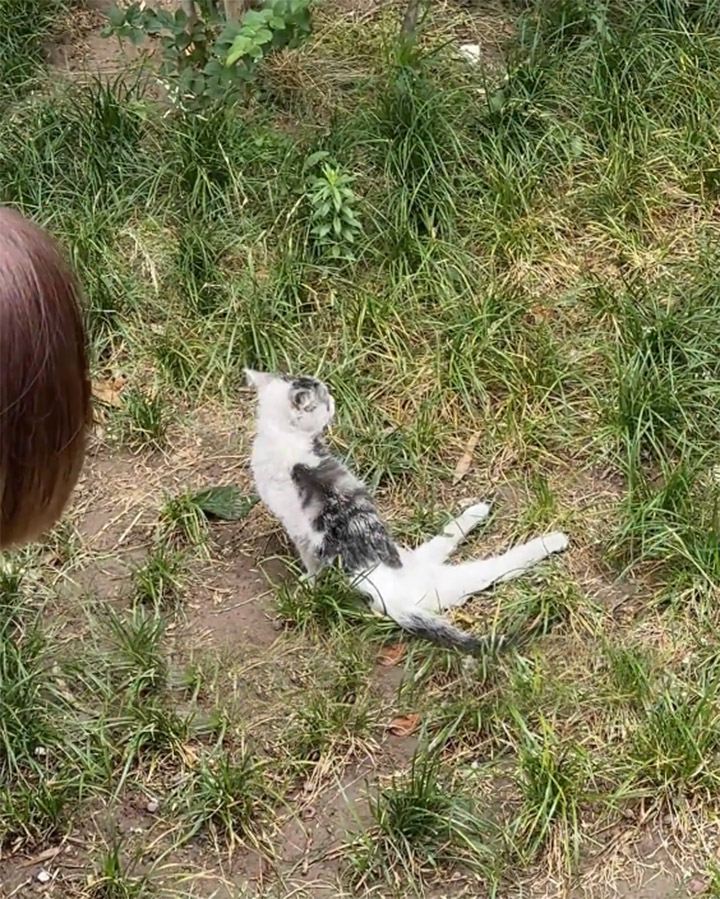
That distinction matters because mobility problems do not always have the same outcome. Depending on the underlying cause, some cats may benefit from medical treatment, surgery, rehabilitation, physical therapy, or supportive equipment. Even when an injury is permanent, many cats can learn to move around safely and comfortably with adaptations to their environment.
For this little kitten, however, the immediate danger was not only his medical condition.
It was where he had been left.
A kitten who cannot use his hind legs has far fewer options when confronted by a vehicle, another animal, extreme weather, or even the ordinary challenge of finding food. Dragging himself across rough ground can also expose vulnerable parts of his body to injury. Without shelter and regular nourishment, a young cat in such a condition could quickly become weaker.
That is why the moment someone stopped mattered so much.
The kitten did not need to be judged by what his body could or could not do. He needed someone to recognize that there was still a life underneath those physical limitations, a young animal who deserved medical attention and the opportunity to feel safe.
And perhaps that is the most important lesson in his story.
Disability does not automatically mean a poor quality of life. Cats with significant mobility challenges can still develop strong personalities, enjoy affection, play with toys, explore their surroundings, and form deep bonds with the people who care for them. What changes is often the way they move through the world, not their ability to experience comfort, curiosity, companionship, and happiness.
This tiny kitten had already been left behind once, but his determination to keep moving told a different story.
His back legs could not carry him toward safety, so he relied on the strength he still had in his front legs. He dragged himself across the grass, slowly closing the distance between himself and the person who had stopped.
He was not asking anyone to feel sorry for him.
He simply needed someone to stop, gently pick him up, and give him the chance to discover what his life could still become.
For a kitten who had begun his journey alone beside a dangerous road, that chance could mean everything.
Watch the video below: