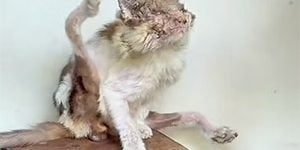
When Eklerka was found, it was difficult to imagine how such a small cat could still be holding on. At only three years old, she had suffered devastating injuries across her body, was severely dehydrated, profoundly weak, and unable to stand or move without help. Her condition was so serious that even breathing appeared to take enormous effort. Yet whenever someone spoke gently to her, Eklerka answered with a faint little meow, as though she were quietly telling the people around her that she was not ready to give up.
Those tiny sounds became one of the most important signs for her rescuers.
They carefully carried Eklerka to a veterinary hospital, where the medical team immediately began working to stabilize her. She needed fluids to address the dangerous dehydration, medication to control her pain, and extensive examination to determine the full extent of her injuries. Her body was fighting a difficult battle, and the severity of the infection made every hour important.
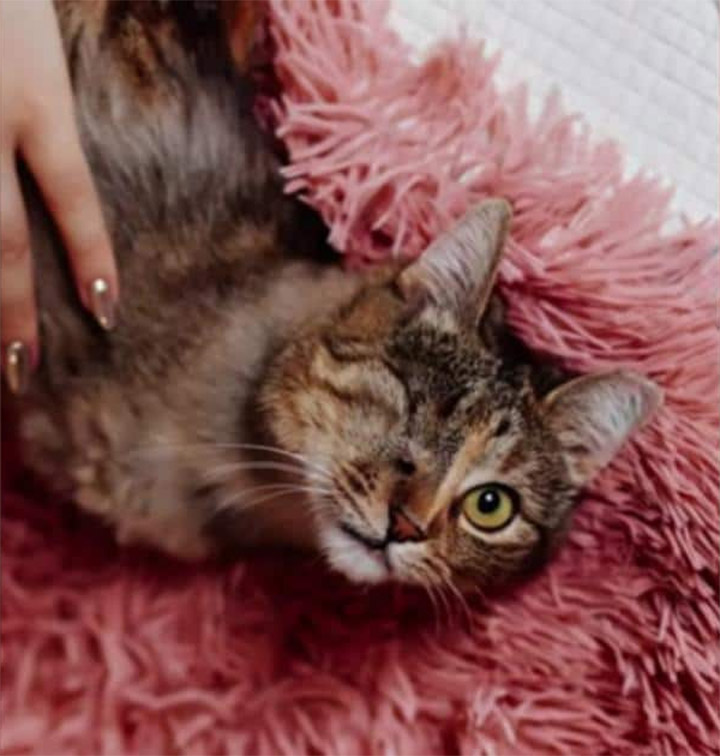
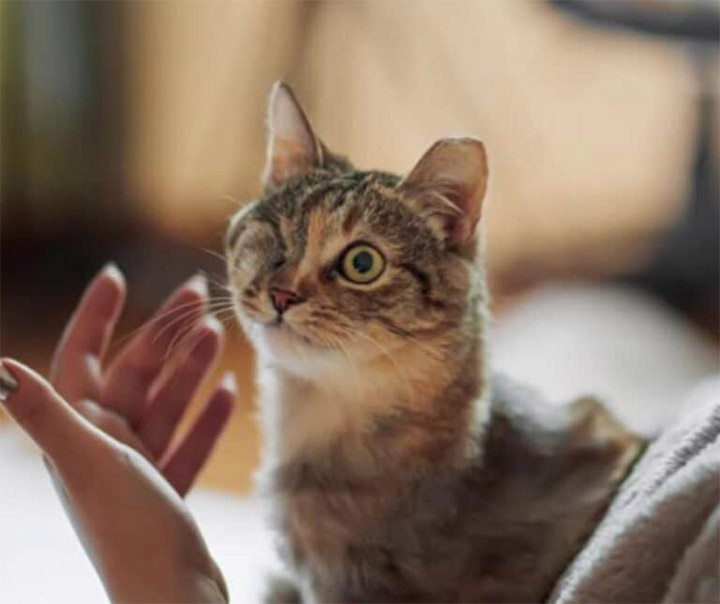
The examination revealed just how much damage she had endured. Large areas of tissue were severely infected, and her anemia was so profound that even obtaining enough blood for testing was challenging. One of her eyes had been destroyed beyond repair, part of her tail was too badly damaged to save, and, most painfully of all, both of her front legs had suffered injuries that could not be preserved.
There were no easy choices left.
Veterinarians had to remove the severely damaged tissue to prevent the infection from continuing to threaten her life. The surgeries would permanently change the way Eklerka looked and moved, but without them, she might not have had a future at all. The goal was no longer to restore her body to the way it had been. It was to give her the possibility of living comfortably again.
When Eklerka woke after surgery, her caregivers watched her closely. They had no way of knowing how she would respond after such a traumatic experience, especially with so much of her physical strength gone.
Then she lifted her head and meowed.
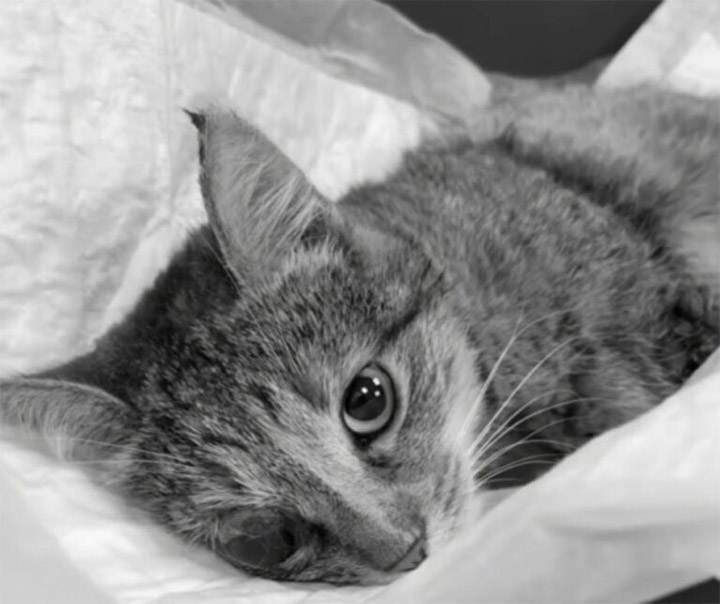
It was a small sound, but to the people who had been caring for her, it meant everything. Eklerka was still responding to human voices. She was still engaged with the world around her, and that fragile response gave everyone another reason to continue believing in her recovery.
The days that followed were filled with small victories rather than dramatic changes. Eklerka received careful medical attention, nutritious food, medication, and plenty of rest. Slowly, her strength began to return. The infection came under control, her body started healing, and she became more alert.
Learning to live without her front legs was another challenge entirely, but cats can be remarkably adaptable when their environment is safe and their needs are properly supported. They rely on balance, vision, hearing, touch, and spatial memory to navigate their surroundings, and with time, many cats with significant mobility differences can develop new ways of moving around.
Eklerka’s caregivers did not expect her to recover all at once. Instead, they celebrated every improvement, whether it was eating a little more, becoming curious about her surroundings, responding to affection, or finding a more comfortable way to move.
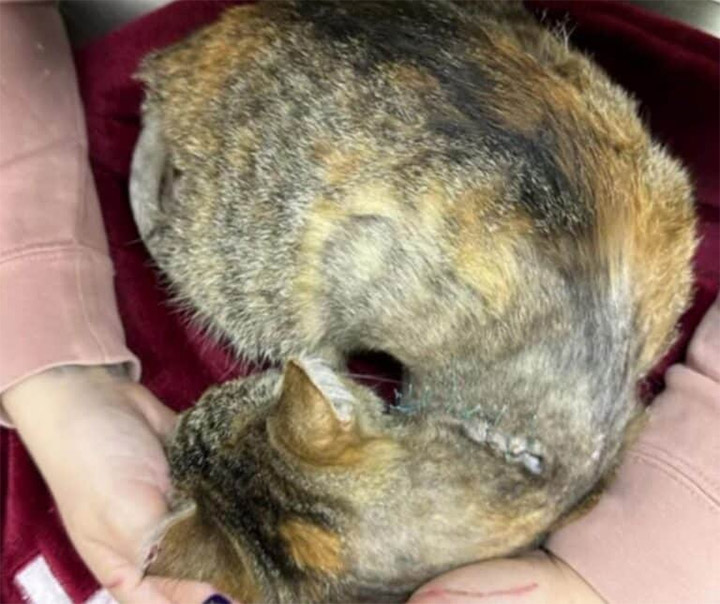
Those small moments gradually became a new life.
The cat who had once been unable to stand now had a chance to explore again. The frightened animal who had arrived in critical condition could finally experience something that had been absent during her darkest days: comfort without fear.
What makes Eklerka’s story especially moving is that her greatest strength was never found in her physical abilities. It was present from the beginning, in those quiet meows she continued to give even when her body was exhausted. She had almost every reason to remain silent, yet she kept responding whenever someone reached out to her.
Today, Eklerka is remembered not for the legs she lost or the injuries she survived, but for the remarkable determination she showed throughout her recovery. Her disabilities changed the way she would move through the world, but they did not take away her ability to experience affection, curiosity, comfort, or companionship.
Her story is also a reminder that recovery does not always mean returning an animal to exactly the life it had before. Sometimes, healing means helping an animal discover a different way to live and giving that animal enough time and support to understand that life can still be good.
Eklerka was given that chance.
Behind her scars is a cat who kept fighting when everything seemed uncertain. Behind every quiet meow was a small expression of trust. And behind the difficult beginning of her story is something far more hopeful—a life that continues because compassionate people refused to decide that her injuries were the end.
Eklerka may move through the world differently now, but she is still here to experience it.
And sometimes, that is the most meaningful victory of all.
Watch the video below: