
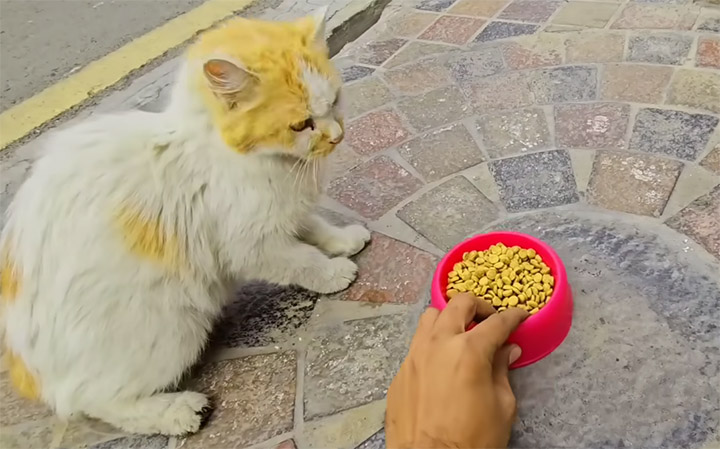
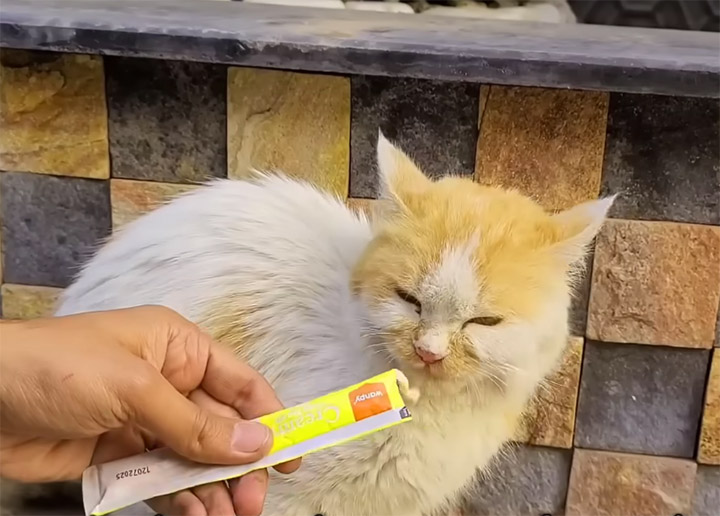
It was the kind of evening when nothing seemed unusual. The neighborhood was settling into its familiar rhythm, with people returning home, cars passing quietly along the streets, and the last traces of daylight disappearing between the houses. Then, in the middle of that ordinary scene, a small mother cat appeared, moving with an urgency that immediately set her apart from the calm surroundings. She was tired, thin, and visibly distressed, but she seemed to have only one thing on her mind. She needed someone to follow her.
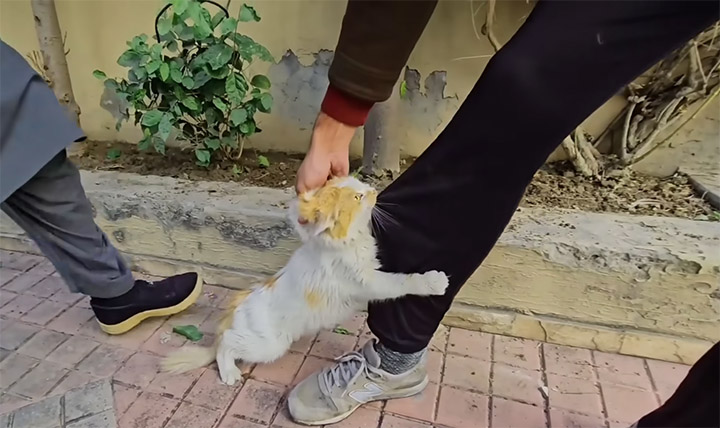
A man walking through the neighborhood noticed the cat approaching him, but instead of simply passing by, she stayed close. She moved around his legs, looked back repeatedly, and then gently tugged at his clothing before turning in the direction from which she had come. When he tried to continue walking, she returned again, almost as though she was insisting that he pay attention.
There was something unusual about her behavior.
The cat did not appear interested in food, nor did she seem to be seeking shelter for herself. Her attention remained fixed on a particular place nearby, and every few moments she glanced back at the man as if checking whether he was following.
Curious and concerned, he finally decided to see where she was going.
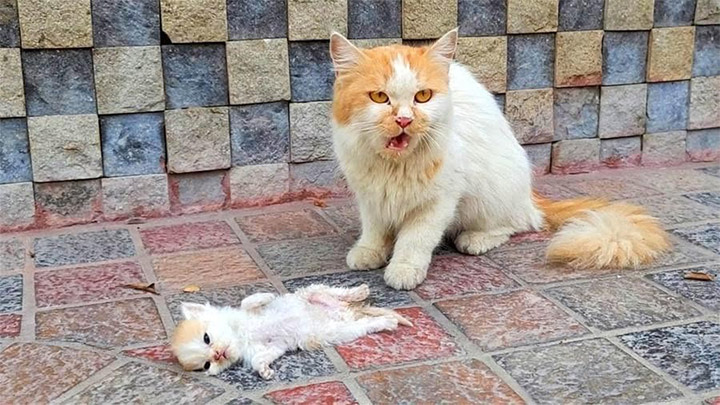
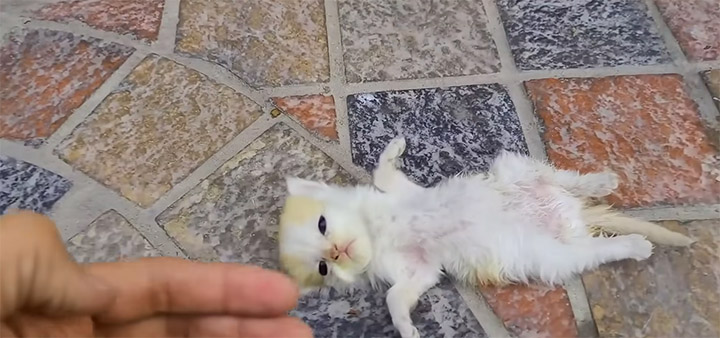
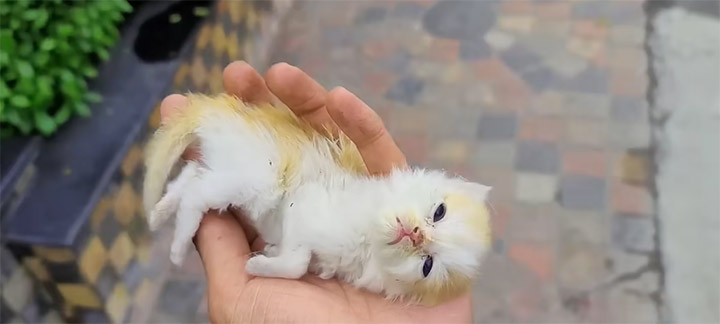
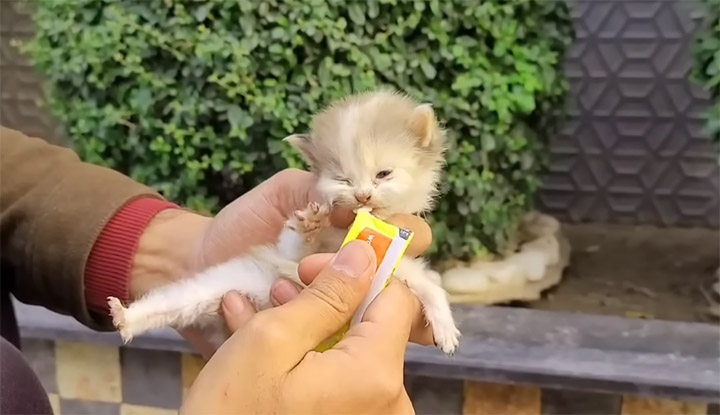
The mother cat led him toward a tree a short distance away. Beneath its branches was a tiny kitten lying almost motionless. The kitten appeared extremely weak, and from the way the mother remained beside it, repeatedly looking toward the approaching man, it was clear that something was seriously wrong.
The scene was heartbreaking.
The kitten was far too young to survive without its mother, yet even the mother’s efforts were no longer enough to keep the little body safe. She had apparently done everything within her ability to protect her baby, but she had reached the point where she needed something she could not provide herself.
And so she had taken an extraordinary step.
She had approached a human.
For the man, seeing the fragile kitten transformed what had initially seemed like strange feline behavior into an urgent rescue situation. The mother cat had not been wandering aimlessly. She had been trying to draw someone’s attention toward her baby.
Although it is tempting to describe such moments as animals consciously communicating with humans in exactly the same way people communicate with one another, animal behavior experts encourage a more careful interpretation. Cats are highly observant and adaptable animals, and mothers are particularly attentive to the condition and safety of their offspring. When a kitten becomes sick, injured, cold, or unusually weak, a mother may change her behavior dramatically, increasing vocalizations, moving the kitten to another location, or searching for a safer environment.
In areas where cats regularly encounter people, humans can also become part of that environment.
A mother cat may learn that certain people provide food, water, shelter, or protection. Under stressful circumstances, those previous experiences can influence her behavior. What appears to us as a deliberate request for help may actually be a complex combination of instinct, learned association, environmental familiarity, and desperation.
Whatever the precise explanation for this particular mother’s behavior, the result was undeniable.
A vulnerable kitten had been noticed.
And that mattered.
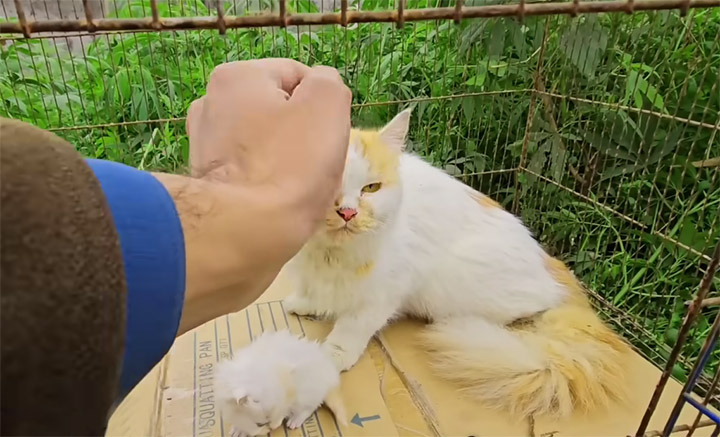
The man carefully approached the kitten while keeping his movements slow and calm. The mother remained nearby, watching closely rather than disappearing. Her behavior suggested that she was willing to tolerate his presence because something more important than her natural caution had taken priority.
Her baby needed help.
For a mother cat, the first weeks of a kitten’s life are an extraordinarily demanding period. Newborn kittens cannot regulate their body temperature effectively, depend upon their mother for nutrition, and require regular grooming and stimulation. A healthy mother spends much of her time keeping them warm, nursing them, cleaning them, and protecting them from potential threats.
When one kitten becomes seriously ill, the mother faces a difficult situation.
She can provide warmth and milk, but she cannot administer medication, treat an infection, repair an injury, or provide intensive medical support. In a desperate situation, seeking a safer location or approaching a familiar source of assistance may be one of the few options available to her.
That is what makes this story so emotionally powerful.
The mother cat could not explain what was happening.
She could not describe the kitten’s symptoms.
She could not ask for a veterinarian.
Instead, she used the tools available to her: movement, eye contact, proximity, vocalization, and persistence.
She caught someone’s attention.
And the man listened.
Stories like this resonate so strongly with people because the underlying emotion is immediately recognizable. Across cultures and throughout history, the image of a mother trying to protect a vulnerable child has carried extraordinary emotional weight. Whether the mother is human or animal, the basic pattern is familiar: something precious is in danger, ordinary solutions are no longer enough, and the caregiver refuses to stop searching for a way forward.
Cats have long occupied a fascinating place in human culture. They are often described as independent, cautious, and selective about social interaction, which makes moments of unusual dependence or trust especially striking to observers. When a cat that would normally avoid people approaches a stranger during a crisis, it naturally captures our attention because the behavior appears to cross a boundary we associate with feline independence.
Yet perhaps the most meaningful lesson is not that the mother cat somehow understood humans exactly as we do.
It is that animals are capable of adapting.
They observe their surroundings.
They remember experiences.
They recognize individuals.
They learn which environments are safe and which are dangerous.
And when circumstances change, they can modify their behavior accordingly.
Research into cat behavior has shown that cats are capable of recognizing familiar human voices and individuals, responding differently depending on their previous experiences. A stray cat living around people may develop an understanding that humans can represent both danger and opportunity. Some people may frighten them, while others provide food or safety.
That distinction can become especially important during a crisis.
The mother cat’s behavior may therefore have been shaped by a combination of instinct and experience. Her maternal drive told her that the kitten was in trouble, while her experience of the human environment may have suggested that approaching a person was worth the risk.
She made a choice that required courage.
She stepped toward something she could not fully understand because the life of her kitten mattered more than her own fear.
As the story spread across social media, many people interpreted the encounter as a mother literally asking a human to save her baby. While we cannot know exactly what was happening inside the cat’s mind, there is no reason to dismiss the emotional significance of what people witnessed. The safest approach is to appreciate the behavior without pretending to know more than the evidence allows.
Perhaps she was intentionally seeking assistance.
Perhaps she had learned that humans could provide resources.
Perhaps instinct simply drove her toward the nearest potential source of safety.
It may have been all three.
And that uncertainty does not make the moment less beautiful.
If anything, it makes it more fascinating.
Animals do not need to think exactly like humans for their behavior to matter. They experience fear, attachment, stress, comfort, and the need for security in ways that are shaped by their own biology and environment. Recognizing those differences allows us to appreciate them without forcing human explanations onto every action.
For the man who encountered the mother cat, however, the scientific question probably mattered less than the immediate reality in front of him.
A tiny kitten was in trouble.
A mother was refusing to leave.
And someone had finally noticed.
What happened afterward serves as a quiet reminder of how important it is to pay attention to the animals living around us. A stray cat hiding beneath a vehicle, a kitten crying near a building, or an animal repeatedly approaching people may be communicating distress in the only way it knows how.
Not every unusual behavior is a request for help, but when an animal appears injured, weak, or persistently tries to draw attention toward a specific location, taking a moment to investigate can sometimes make an enormous difference.
The mother cat’s actions also remind us that compassion begins with observation.
We cannot help what we refuse to see.
In a world where people often move quickly through their daily routines, it is easy to overlook a frightened animal standing at the edge of the road or hiding beneath a tree. Yet sometimes the smallest interruption to our routine can lead to a moment we remember for the rest of our lives.
That evening, one mother cat refused to accept that her kitten’s story was over.
She could not carry the kitten to a hospital.
She could not call for a veterinarian.
She could not explain her fear.
But she could approach someone.
She could tug at his clothing.
She could turn around and lead him toward the place where her baby lay.
And she did exactly that.
Whether we interpret her actions primarily through instinct, learned behavior, or an extraordinary combination of both, the message of the encounter remains powerful.
A vulnerable life needed attention, and a human chose to listen.
Perhaps that is the part of the story worth remembering most.
We may never know precisely what the mother cat was thinking when she looked into that stranger’s eyes. We may never know whether she understood that he could help or whether she was simply following an instinct that had never failed her before.
But we do know what her behavior accomplished.
She refused to walk away.
She kept searching.
And somehow, in the quiet streets of an ordinary neighborhood, that persistence created a bridge between two very different species.
Sometimes compassion begins with a cry.
Sometimes it begins with a paw touching your leg.
And sometimes, it begins when a frightened mother cat looks at a stranger and gives him one simple reason to follow her.
Her kitten.
Her hope.
And the chance for a life to be saved.


